No Net Loss
Wetlands Policy in Virginia: 2025 Review. A Wetlands Watch series
Part One: Wetlands Compensatory Mitigation Policy
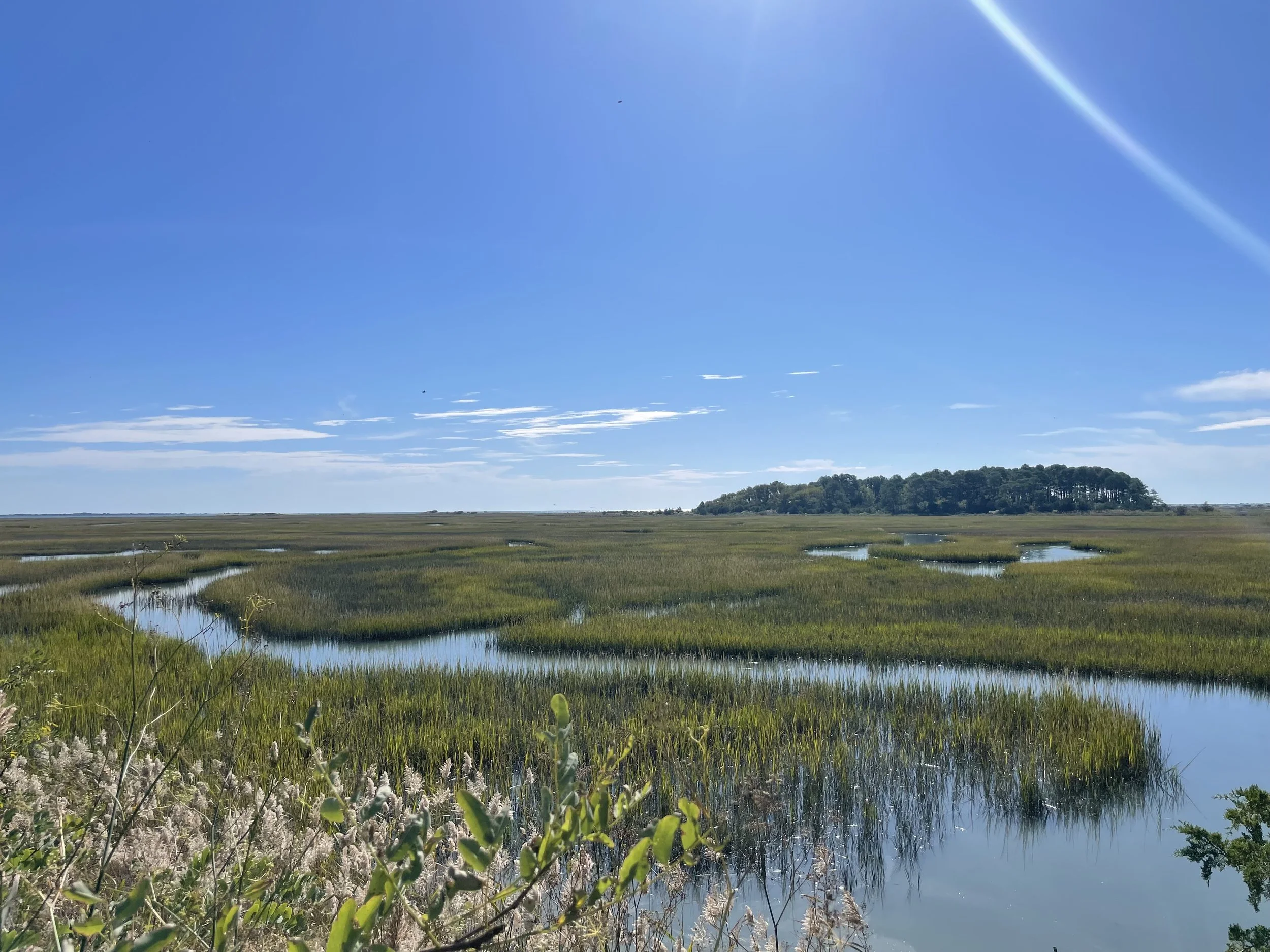
Salt marsh on the Eastern Shore of Virginia. Photo credit: U.S Fish and Wildlife Service
2025 was a tumultuous year for Virginia’s wetlands policy. From federal policy, to state policy, to local issues, Virginia has been grappling with the task of managing “no net wetland loss” amid increased development and climate change. This series will unpack the mitigation debates that defined the year. We start with the legal and policy basics of compensatory wetlands mitigation, then move to the projects, guidance updates, and contested standards that reveal how challenging “no net loss” can be in practice.
Compensatory wetlands mitigation is the mechanism by which the government enforces “no net loss.” When a permit allows a wetland to be destroyed, it typically includes a requirement to compensate for and offset the damage. The idea is that the total wetland acreage and function in a region stay roughly constant, even as individual sites are lost to development.
This article begins a short series on the mitigation controversies that played out in 2025. To see why these disputes mattered and why the arguments turn technical almost immediately, we need a shared baseline: what compensatory wetlands mitigation requires and what a mitigation bank is designed to do in practice.
Background
In 1977, President Carter advanced a federal policy (via Executive Order 11990) that recognized the importance of preserving wetlands and the many benefits they provide.
Declaring a policy, however, is easier than carrying out the difficult work of maintaining and enforcing it. As regulators confronted the recurring tension between wetland protection and economic development, compensatory wetlands mitigation emerged as a way to address wetland losses that seemed unavoidable.
In the simplest terms, wetlands compensatory mitigation is the policy framework used when a wetland is damaged or destroyed as part of a permitted activity (usually some form of development or land disturbance). Under Section 404 of the Clean Water Act, permit applicants must 1) take all practicable steps to avoid adverse impacts to wetlands, 2) minimize damage that cannot be avoided, and 3) compensate for permanent wetland loss either by creating a new wetland or restoring a degraded one. Together, these measures are referred to as mitigation.
The Clean Water Act of 1972 established the modern framework for regulating discharges into waters of the United States, including many wetlands. It also sets the terms of the policy bargain that resides at the center of compensatory mitigation: development may proceed, but wetland losses must be avoided where possible, minimized where unavoidable, and otherwise offset through replacement.
In Virginia, this bargain is carried forward through a commitment to “no net loss,” captured in the line: “Compensatory mitigation for project impacts shall be sufficient to achieve no net loss of existing wetland acreage and no net loss of functions in all surface waters” (italics ours). This sentence is crucial to understanding the 2025 wetland debates because the issue is not simply whether compensation occurs, but whether it is sufficient to replace both the acres and the work that wetlands perform.
Acreage vs. Function
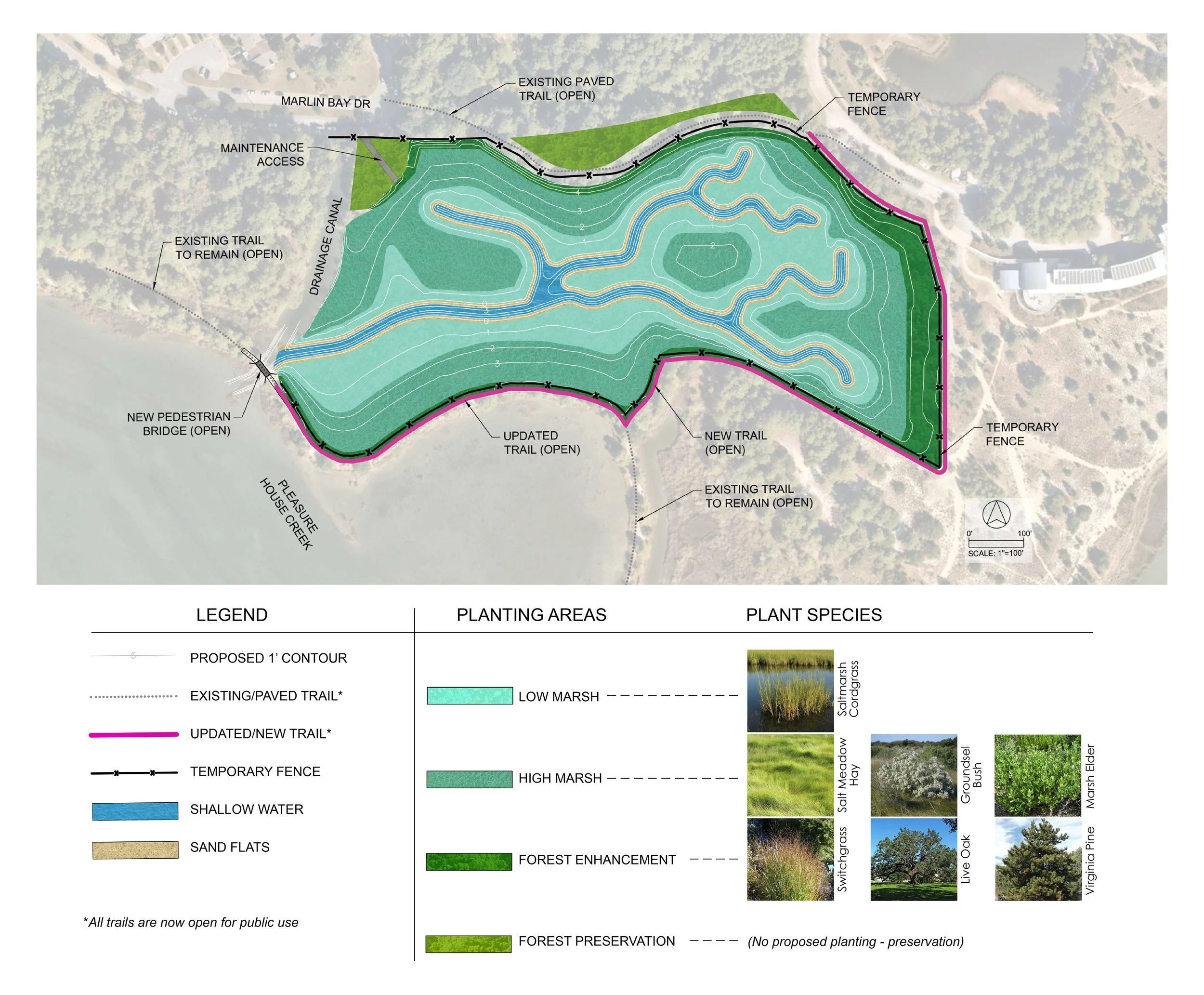
Site plan of the Pleasure House Point Wetlands Restoration Project in Virginia Beach.
Virginia’s statutory language is important because it clarifies what “no net loss” actually measures. One part is relatively straightforward: acreage, which is easier to see and count. In many cases, a wetland footprint can be mapped and measured with reasonable confidence–a quick trip to Google Earth can generate acreage estimates with just a couple of clicks.
The second part of the standard, however, is more demanding: function. Here the law’s practical meaning becomes much more consequential because it refers to how wetlands operate as natural infrastructure. Wetlands hold water during storms and high tides, moderate surge and flooding, and help protect shorelines and adjacent neighborhoods. They also improve water quality by trapping sediment and excess nutrients, and they sustain habitats that support fisheries and wildlife. These are the functions Virginia law requires to be maintained, and they are often the first things to erode when compensation is distant, delayed, weakly designed, or assessed mainly in terms of acreage.
When we read about mitigation, it’s important to make sure both components are considered. Acreage can be replaced on paper with little trouble. Function, however, is more vulnerable to poor site selection, weak performance standards, inadequate monitoring, and long delays between the destruction of wetlands and their required replacement projects. Taken together, these weaknesses can produce a system in which compliance is documented on paper even as wetland function is substantially reduced on the ground.
Once function becomes the real measure of sufficiency, all of the local details–including location and setting–begin to matter much more. A replacement wetland is more likely to perform comparable work when it is connected to the same water source, shaped by similar hydrology, and situated in the same general landscape context as the wetland that was lost.
This preference for functional continuity helps explain why the 2025 disputes carried such weight. The real question was whether the available mitigation mechanisms were replacing what had actually been lost, in place and in time, or whether Virginia was allowing a statutory commitment to “no net loss” to be satisfied solely through acreage accounting. At stake was whether the Commonwealth would treat wetlands as working systems that protect communities and watersheds, or as interchangeable acreage plots that can be balanced from a distance.
Main Pathways for Compensation
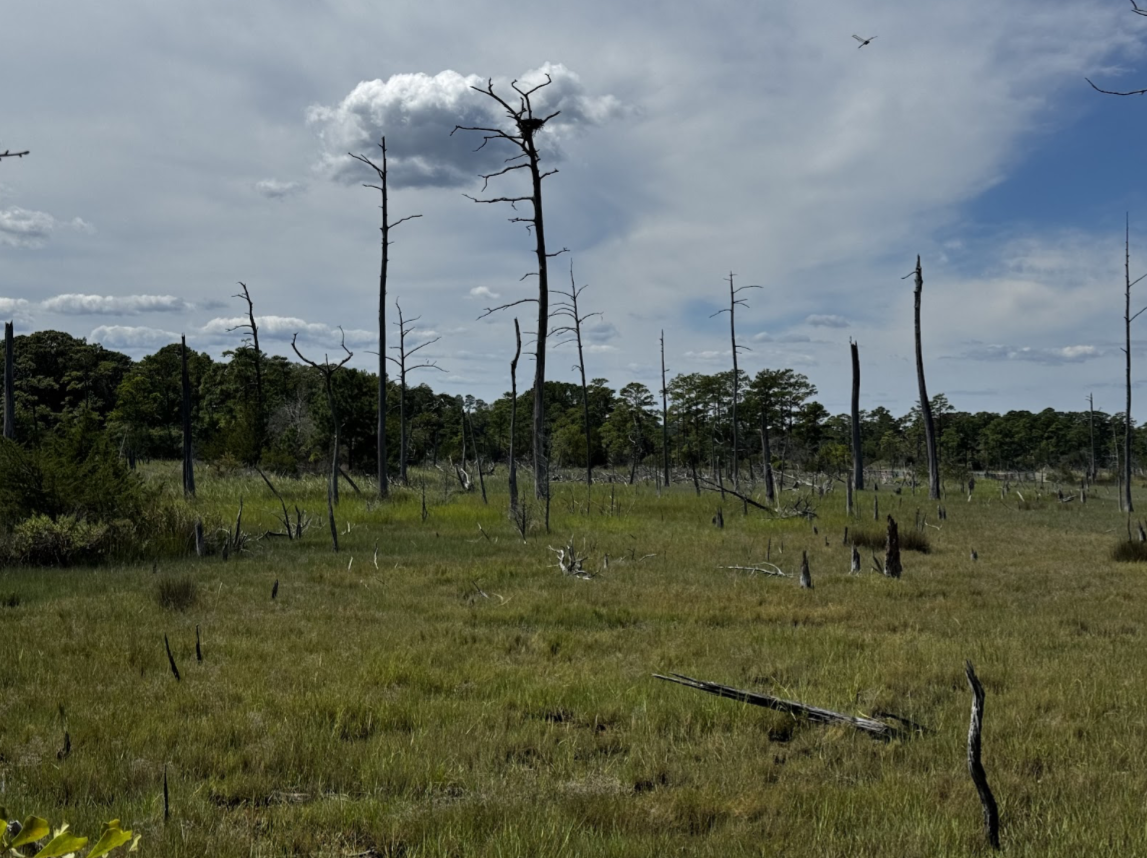
Ghost forest at First Landing State Park, Virginia
The mitigation sequence begins with avoidance, then minimization, and finally compensation for permanent wetland loss. Once a project reaches that third step, the questions become practical very quickly: how will compensation be delivered, where will it occur, and who will be responsible for whether it succeeds over time.
At the federal level, compensatory mitigation is generally organized into three primary pathways: permittee-responsible mitigation, which is a fancy way of saying the applicant who receives a permit is directly responsible for replacing the wetlands either on-site or off-site; in-lieu fee programs; and mitigation banks. In Virginia, a fourth mechanism has also operated in practice through some local wetland boards in the form of local in-lieu fees.
Each of these pathways reflects a different understanding of how “no net loss” is supposed to work in practice, and each depends on a different mix of expertise, proximity, timing, monitoring, and enforceability. This is why the disputes of 2025 turned so heavily on them. The question was not merely which pathway was available, but which one was most likely to preserve wetland function where loss occurred, and which ones were more likely to produce a form of compliance that looked sufficient in the file while proving clearly insufficient on the ground.
Mitigation Carried out by Permittee. Anyone seeking to destroy wetlands in the United States' jurisdictional areas must obtain permission before proceeding with any development or land disturbance. The entity can truly be anyone: a state agency building a road, a commercial developer building a shopping center, or a property owner wanting to use fill to elevate their house in a way that would alter the site's hydrology. Originally, when mitigation was being put forward, permittee-responsible mitigation, where the developer designs, builds, and maintains the compensatory wetland work, was the primary pathway. This can occur on-site, elsewhere on the same parcel, or off-site at a different location, ideally within the same watershed and as close to the impact as practicable. On-site mitigation has the strongest case for functional continuity, since similar landscape conditions, soils, and water sources are more likely to support comparable hydrology and ecological function. Off-site mitigation can make sense when parcel space is limited or when restoration potential is stronger elsewhere, but distance immediately raises the question of whether the place of replacement is meaningfully compensating for the place of loss.
This pathway also places substantial weight on the developer’s technical capacity and long-term follow-through. Wetlands are easier to destroy than to rebuild. Construction can alter hydrology in subtle but decisive ways, and problems such as sedimentation, shifted drainage patterns, and disrupted water flow can undermine outcomes even when acreage targets are met. Long-term success also depends on strong performance standards, adequate monitoring, and enforceable adaptive management. When these elements are weak, the burden of restoration falls hardest where this pathway is already most vulnerable: in the long, difficult work of turning disturbed ground back into a functioning wetland. Because monitoring periods are limited and wetland creation is a delicate science that requires sustained expertise and close attention to site conditions over time, many point out that permittee-responsible mitigation often fails, especially when a developer passes the site to a business with little background in wetland science. Recognizing this limitation, a second approach emerged.
In-Lieu Fee Programs. A second pathway is the in-lieu fee program, where a permittee pays a fee instead of designing and implementing a restoration project directly. Because most permittees are not wetland restoration specialists, this approach shifts responsibility to an approved sponsor that can pool fees, select stronger sites, and deliver larger, more coherent projects than an assortment of small, permittee-built efforts. In Virginia, this role is associated with the Virginia Aquatic Resources Trust Fund.
The difficulty here is that this advantage depends heavily on execution. Fees can be set too low to match the real costs of restoration, especially when impacts are small and dispersed. Money can accumulate slowly and unevenly, and projects can lag behind impacts. In this scenario, wetlands are lost immediately while replacement arrives later, often in a different place, and sometimes at a scale that struggles to recover the lost function. When pricing, project selection, and implementation are strong, in-lieu fee programs can support meaningful restoration. When they are weak, “no net loss” begins to read less like ecological replacement and more like deferred accounting.
Mitigation Banks. A third pathway is the mitigation bank, where a specialized sponsor restores or creates wetlands under an approved plan and then sells credits to permittees who need compensation for unavoidable impacts. The idea here is to concentrate mitigation into larger projects that are run by restoration professionals, and are supported by clearer performance standards than many small, one-off efforts can sustain. In principle, this structure offers a way to reduce the technical and managerial weaknesses that often trouble permittee-responsible mitigation.
As one might expect by now, mitigation banks do not eliminate the core tensions of “no net loss”; they relocate them. Depending on a bank’s service area, credits may be used at some distance from the impact site, which can weaken the connection between the place of loss and the place of replacement even when the regional ledger appears balanced. Timing also becomes critical. A mitigation bank converts ecological performance into tradable credits, which are typically released in phases based on milestones and performance standards. If the timing of this release is too flexible or if standards are too permissive, wetlands can be destroyed before replacement functions have even started. Depending on how they are implemented, mitigation banks can either strengthen Virginia’s promise of “no net loss” or widen the gap between formal compliance and actual functional replacement.
Local Wetland Board In-Lieu Fees (Virginia). In Virginia, a fourth mechanism has also operated through some local wetland boards in the form of local in-lieu fees. Under this approach, a permittee pays a fee in lieu of designing and implementing a specific mitigation project, which then remains under the jurisdiction of the local wetlands board. For small, incremental impacts, this can seem efficient. It avoids forcing a permittee to devise a restoration plan for a very small parcel, and it gives a locality a pool of money that, at least in theory, can be directed toward a more coherent restoration effort when an appropriate opportunity arises.
At the local level, however, the same familiar pressures begin to reassert themselves. Fees can be set inconsistently across jurisdictions and may not reflect the true costs of restoration or the value of the functions lost. Revenue can arrive in small, uneven increments, especially when impacts are dispersed across many minor projects, which makes it difficult to assemble enough funding for a legitimate restoration effort on a reliable timeline. In this scenario, wetlands are destroyed or degraded in the present while replacement is deferred into an uncertain future. Local in-lieu fees can work when a locality treats the fee as the front end of an actual restoration program, with realistic pricing, identified sites, technical partners, and a credible path to construction and monitoring. When the programmatic commitment is weak, the system can register compensation without producing a functioning wetland that is required under “no net loss.”
Conclusion
With these pathways and the vulnerabilities that attend each of them in view, the 2025 disputes come into clearer focus: they were arguments about whether Virginia’s statutory commitment to “no net loss” was being carried out in a way that could reliably replace wetland function where it was lost, and on a timeline that made replacement ecologically meaningful. Put a little differently: the controversies of 2025 were not disputes about mitigation in the abstract, but about the very practical question of whether the Commonwealth was preserving the actual protective and ecological work of wetlands, or allowing that work to be translated into quite a thin form of compliance.
Looking Ahead
In Part Two of this series, we will move from the general logic of compensatory mitigation to the revised compensation order that took effect for the Virginia Marine Resource Commission and subsequent Wetland Boards in February 2025. This update elevated tidal wetland mitigation banks to the top of the hierarchy; a significant shift that brings both promise and new scrutiny. Chief among the concerns: what counts as sufficient compensation, and why a single word in the one-to-one ratio language can determine whether Virginia’s “no net loss” policy is being pursued on the ground, or just on paper. We will also walk through how mitigation banks are created, what to look for in a Prospectus, and the questions worth asking when a bank is proposed in your watershed.