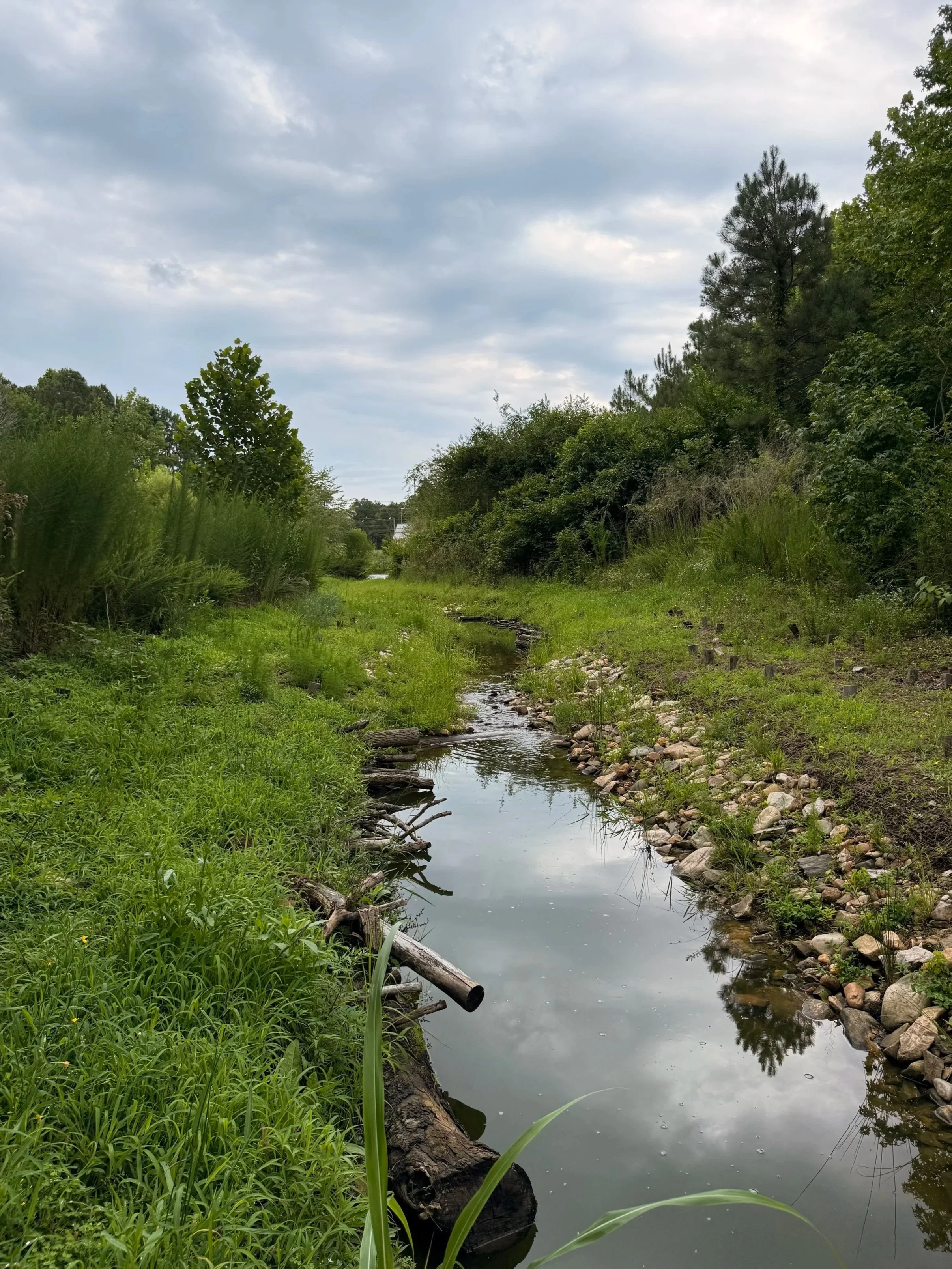
Restored stream / buffer best management practice in York County
Wetlands Watch is participating on the Historic Triangle Resilience Adaptation Feasibility Tool (RAFT) initiative implementation steering committees with York County and James City County residents and staff. The RAFT helps Virginia localities improve climate resilience through the community-focused “collective impact” approach led by an interdisciplinary academic team composed of the University of Virginia Institute for Engagement & Negotiation, the Virginia Tech Coastal Collaborator, and Old Dominion University’s Institute for Climate, Adaptation and Resilience. Shereen Hughes, Wetlands Watch Ambassador, is a member of the James City County (JCC) RAFT Implementation steering committee and attends in person and online James City County RAFT meetings and co-leads the JCC RAFT Team focused on incorporating new data and HRPDC guidance on sea-level rise and rainfall projections, tailwater elevations, and joint tidal/rainfall design storm into analyses planned for the upcoming flood resilience plan, two watershed management plans, and two flood modeling studies. During her Virginia Sea Grant fellowship, Amari Ross, Wetlands Watch Neighborhood Resilience Project Manager, evaluated resilience needs and conducted citizen outreach in the Grove area to inform the JCC RAFT scoring and assessment phase. Genevieve Guerry, Wetlands Watch Flood Risk Project Staff and Community Rating System (CRS) Workgroup Chair, is a member of the York County RAFT implementation steering committee attends monthly in person meetings to determine priority resilience actions to reduce stormwater and tidal flooding impacts across the County. During the York RAFT process, the teams toured stormwater management best management practices (BMP) throughout the communities, such as rain gardens, impervious pavement, and restored streams and culverts. As part of the RAFT project, community members are given an opportunity to engage directly in flood resilience planning and offered a platform to prioritize the resilience actions that residents actually want.
Following the York County RAFT’s last in person meeting this month, Genevieve will continue to support York County with her CRS expertise. FEMA’s CRS program offers flood insurance premium discounts to local governments that implement floodplain best management practices, such as protecting Chesapeake Bay buffers and wetlands. Genevieve hopes her work with York County will help the County receive the maximum amount of CRS credit for their conserved and protected land. Additionally, she hopes the County will receive “extra credit” for participating in a regional public information program hosted by the Hampton Roads Planning District Commission. We are excited to support York County in their efforts to transition from a CRS Class 7 to Class 6 locality, which will increase the annual flood insurance discount for policy holders from 15% to 20%. In helping the County review its CRS scores, Wetlands Watch is incentivizing building long-term adaptation against climate change and flooding, while saving York County residents on annual flood insurance costs.
